


Parkinson’s disease is the fastest growing neurological condition in the world.
NRF supports leading South Australian research to improve the diagnosis, treatment and quality of life of people impacted by Parkinson’s disease.
Support Parkinson’s research
Parkinson’s disease is a progressive neurological condition that affects the brain and nervous system. While it is often associated with movement problems, Parkinson’s can affect many different aspects of a person’s health and daily life.
There is currently no cure for Parkinson’s disease. Researchers are working to better understand how the condition develops, how it can be detected earlier and how treatments can be improved.
Parkinson’s and the brain
Parkinson’s is associated with changes in the brain, including the gradual loss of cells that produce dopamine. Dopamine is a chemical messenger that plays an important role in controlling movement.
As dopamine-producing cells are lost, people can experience changes in movement. Parkinson’s can also affect sleep, mood, thinking, speech, digestion and energy levels.
The condition affects everyone differently, and symptoms can vary considerably from one person to another.
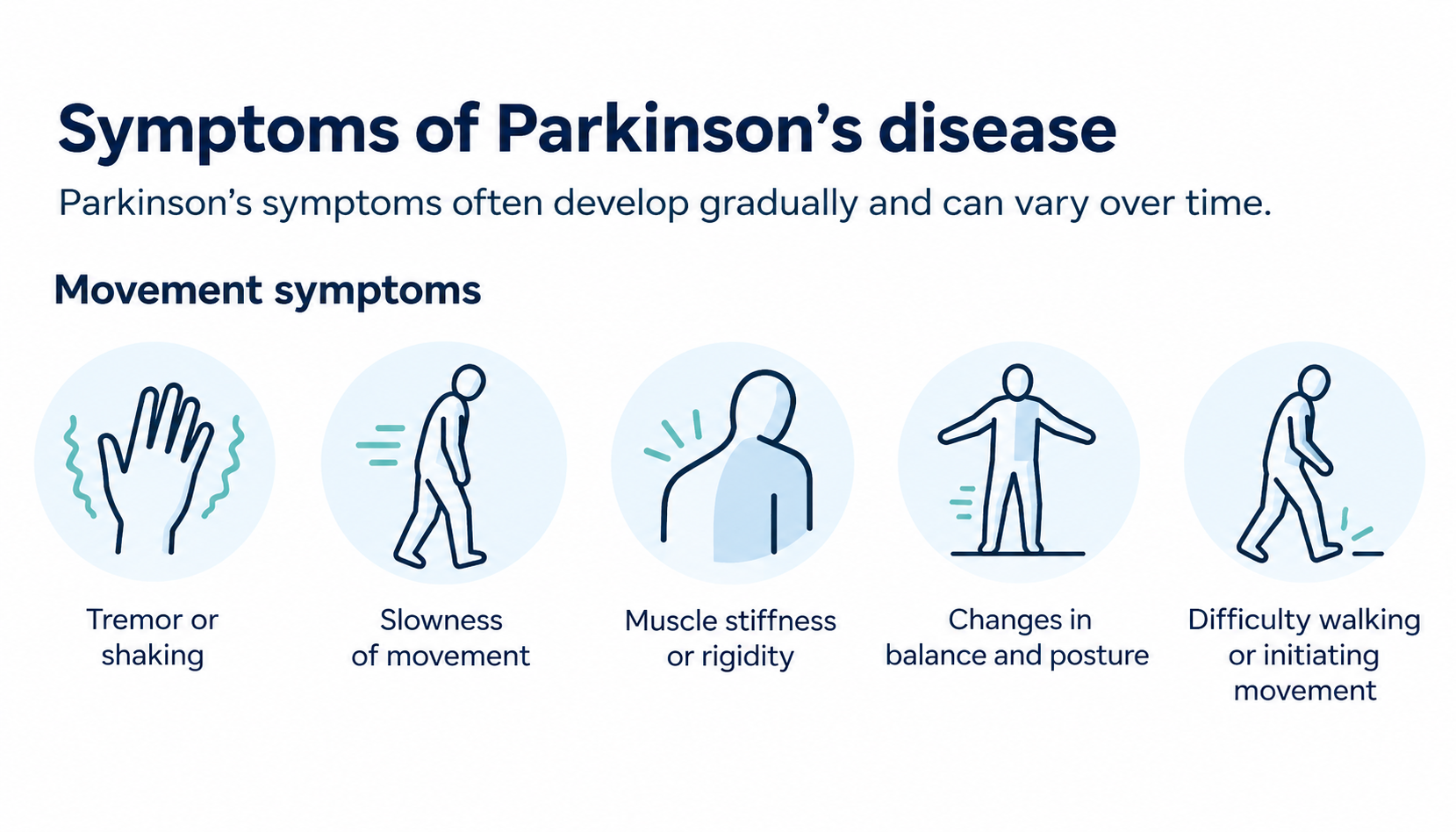
Parkinson’s symptoms often develop gradually and can vary over time.
Movement symptoms
Tremor or shaking
Slowness of movement
Muscle stiffness or rigidity
Changes in balance and posture
Difficulty walking or initiating movement
Parkinson’s can also cause symptoms that aren't always immediately associated with the condition, including:
Fatigue
Sleep difficulties
Changes in mood
Anxiety or depression
Changes in thinking and concentration
Speech or swallowing difficulties
Digestive problems
Changes in sense of smell
Dizziness
Not everyone with Parkinson’s will experience the same combination or severity of symptoms.
Parkinson’s disease is currently diagnosed primarily through a person’s symptoms and clinical assessment. There is no single test that can definitively diagnose the condition.
By the time noticeable movement symptoms develop, changes associated with Parkinson’s may already have been occurring in the brain for some time.
This is one of the areas researchers are working to better understand. Finding reliable biological markers could potentially help identify Parkinson’s earlier and provide a clearer picture of how the disease develops.
At NRF, we support research that aims to answer these questions and improve what we know about neurological conditions such as Parkinson’s disease.
Looking for Parkinson’s earlier
Dr Angus McNamara | $50,000
Dr Angus McNamara is investigating whether a biological marker called alpha-synuclein could help identify people who may be at increased risk of developing Parkinson’s disease.
The research is focusing on people who have experienced traumatic brain injury, as there is evidence that TBI may be associated with an increased risk of developing neurodegenerative conditions later in life.
The research team will study biological samples alongside changes in movement, thinking and overall health over time. These findings will also be compared with people who have a confirmed diagnosis of Parkinson’s disease.
The aim is to determine whether this approach could help identify people at risk of Parkinson’s before more obvious symptoms develop.
If successful, this research could contribute to earlier diagnosis and a better understanding of how Parkinson’s develops following traumatic brain injury.
%20(1).png)
There is still much to learn about Parkinson’s disease.
Research supported by NRF is helping South Australian researchers investigate new approaches to diagnosis and improve our understanding of the changes that occur in the brain.
Your donation can help support neurological research in South Australia and contribute to the ongoing search for better ways to diagnose, treat and understand Parkinson’s disease.
Support Parkinson’s research

