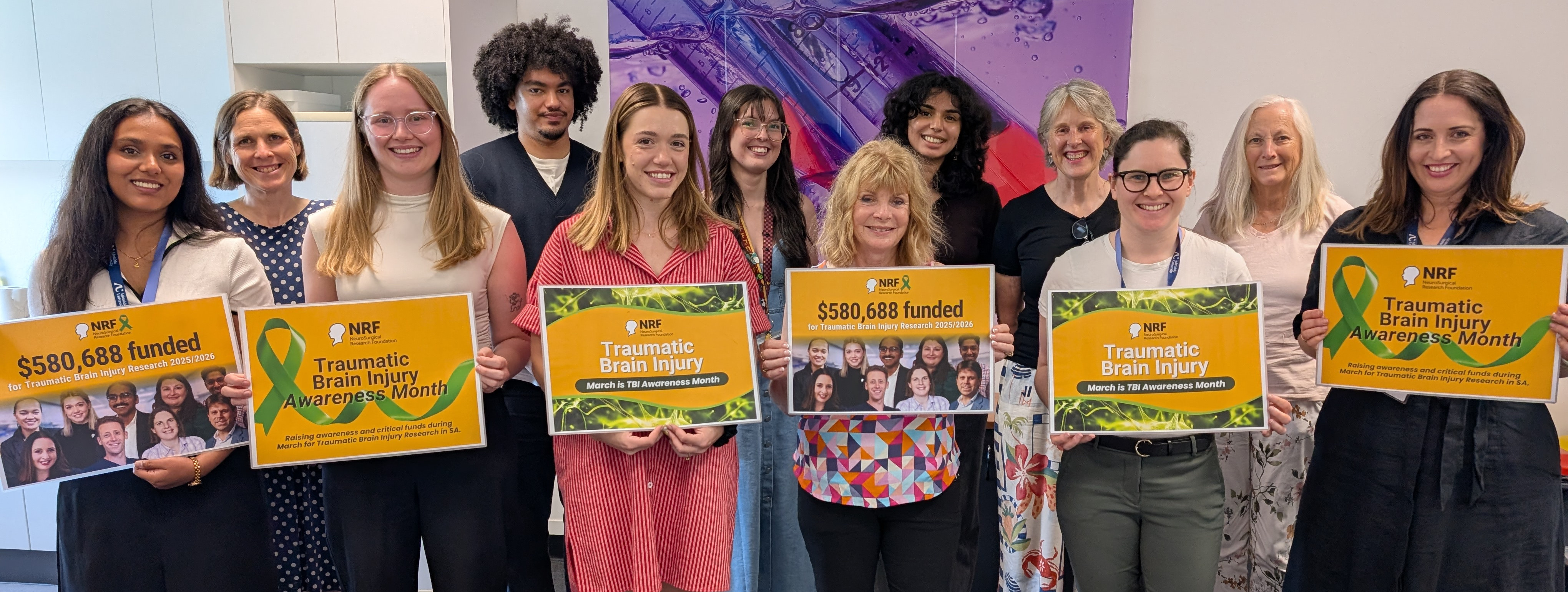


Anthony Walsh TBI & NRF Vacation Scholarships Presented
Four emerging researchers recognised as Christine Walsh and supporters continue Anthony Walsh’s legacy by advancing traumatic brain injury and stroke research.
.png)
Honouring Legacy, Advancing Brain Research
The Neurosurgical Research Foundation (NRF) was proud to present the 2026 Anthony Walsh Traumatic Brain Injury (TBI) Scholarships and 2025 NRF Vacation Scholarships on Tuesday 10 February at the University of Adelaide’s NUMICO Seminar Room.
In attendance were Christine Walsh, friends and family who continue to honour the life and legacy of her late husband, Anthony Walsh — a respected neuropsychologist who tragically passed away following a hit-and-run accident. Through Team Tony Tony Tony, Christine, family and friends continue to fundraise in support of vital traumatic brain injury research.
Anthony’s legacy in neuroscience is deeply rooted. He was the nephew of Australian neuropsychology pioneer Kevin Walsh and his uncle was Jim Dinning, former Head of Neurosurgery at the Royal Adelaide Hospital and co-founder of the Neurosurgical Research Foundation in 1963. Christine and Anthony were both psychologists and ran a practice together, with research always central to Anthony’s life.
During the presentation, Christine shared:
“Thank you for the ongoing research. It all helps. I was a nurse before I was a psychologist, so I supported people who had strokes and head injuries. The changes have been phenomenal really over the last 40 years or so. I look forward to hearing more of what you’re doing.”
2026 Anthony Walsh TBI Scholarship Recipients
Christine Walsh presented the 2026 Anthony Walsh TBI Scholarships to Hasini Kapuwelle (accepted on her behalf by supervisor A/Prof Frances Corrigan due to illness) and Carl Llewellyn Hooper.
Hasini Kapuwelle
Hasini’s PhD research investigates how disruptions to brain energy supply contribute to white matter damage following traumatic brain injury, with a focus on oligodendrocytes and chronic axonal degeneration.
Hasini shared:
“Following a head injury, axons, the long projections of neurons that transmit signals throughout the brain, can become injured. Rather than breaking immediately, many axons continue to degenerate over time, disrupting communication between brain regions and contributing to lasting difficulties with thinking, movement, and emotional wellbeing.
Why this damage progresses long after the initial injury remains poorly understood. Increasing evidence suggests the problem may not lie solely within the axon itself, but in the specialised support cells that sustain it. Oligodendrocytes insulate axons with myelin and provide essential metabolic fuel through long, delicate projections that connect to multiple axons. If this energy supply is disrupted, vulnerable axons may slowly deteriorate.
This project investigates a previously under-recognised mechanism: that injury to oligodendrocytes may drive chronic axonal degeneration after head injury, by impairing delivery of fuel to axons. By identifying how this process occurs, we hope to uncover new therapeutic targets and guide the development of treatments aimed at protecting axons and improving long-term outcomes for patients.
A heartfelt thank you to the Walsh family for their generous support of this preliminary research. Your kindness and belief in this work mean so much to us and help make this important research possible.”
%20(1).png)
Carl Llewellyn Hooper
Carl’s PhD research investigates novel therapeutic peptides for traumatic brain injury, including R18D, which has progressed to early clinical evaluation. The scholarship will also support conference presentation and a long-term study examining cognition, behaviour and brain inflammation following injury.
Carl reflected:
“Traumatic brain injury can have lasting effects long after the initial event, and my work aims to better understand these changes and how we might improve recovery. Receiving an award in honour of Mr Walsh is particularly meaningful given his dedication to advocating for people affected by brain injury, and I am grateful to the Walsh family for their continued generosity in supporting this work.”
.png)
2025 NRF Vacation Scholarship Recipients
NRF Vacation Scholarships were presented to:
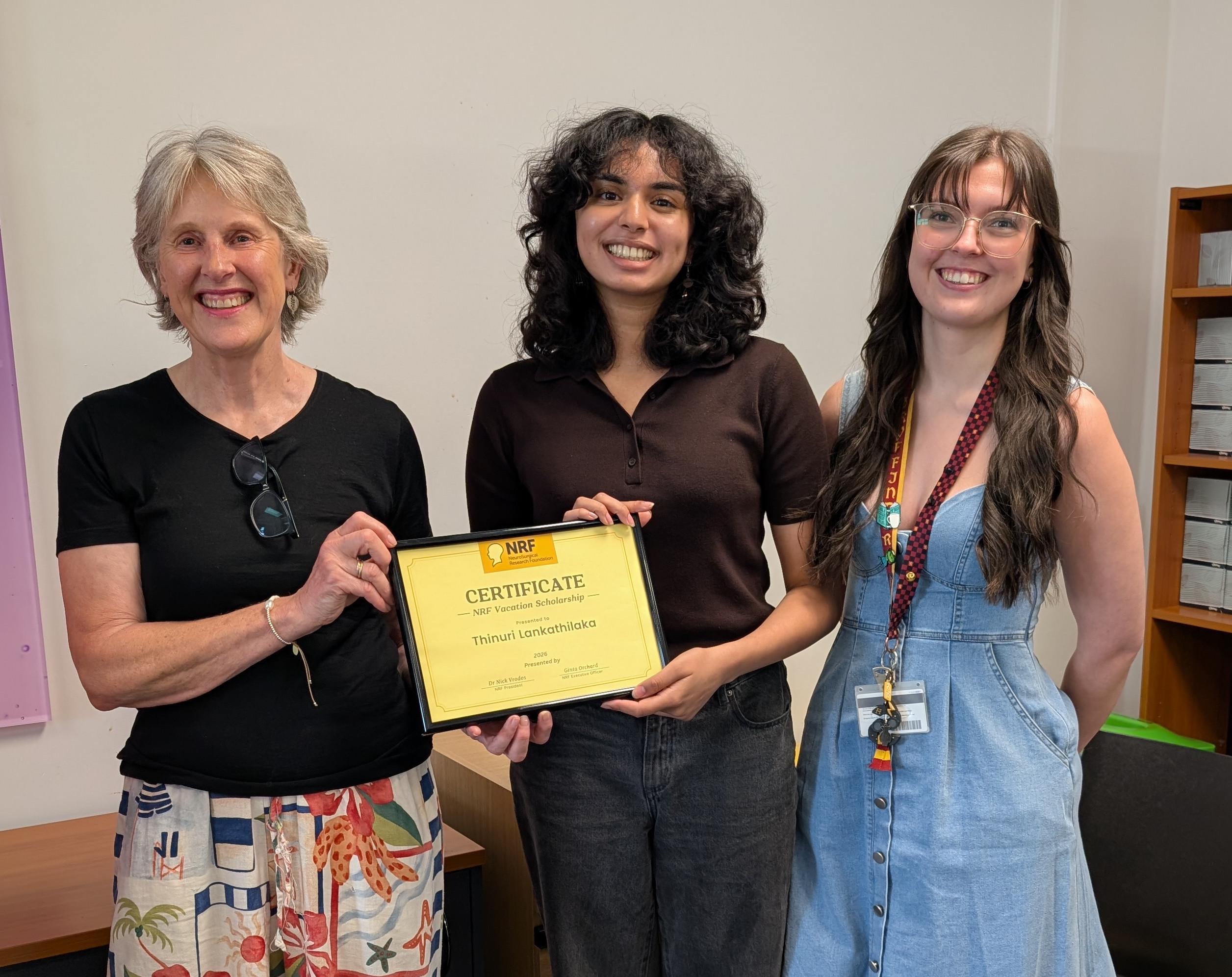
Thinuri Lankathilaka (Supervisor: Dr Shannon Stuckey)
Thinuri’s project investigates the relationship between iron deposition and chronic inflammation in driving secondary neurodegeneration long-term following stroke. By optimising dual-staining techniques and integrating behavioural data, her work aims to clarify mechanisms underlying ongoing functional decline and identify potential therapeutic targets.
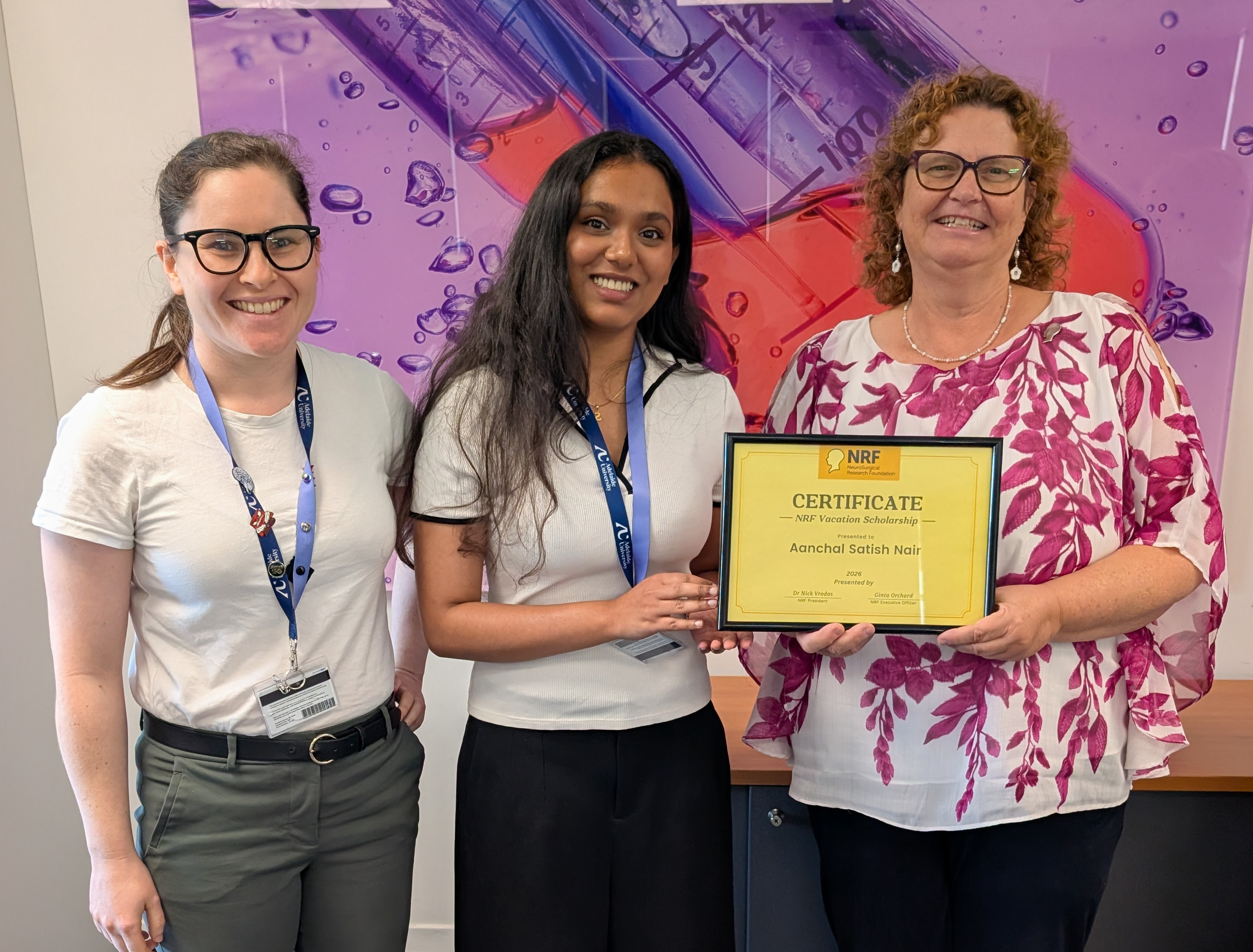
Anchal Satish Nair (Supervisor: Dr Rebecca Hood)
Anchal is investigating the role of microglia in post-stroke secondary neurodegeneration using aged animal models. Her work utilises high-performance computing to quantitatively analyse inflammatory changes associated with neuronal loss, contributing essential insight into stroke outcomes in older populations.
Importantly, both Thinuri and Anchal will now continue into Masters research within the same laboratory — a powerful demonstration of how NRF Vacation Scholarships provide hands-on experience, build capability and support emerging researchers to pursue careers in neurosurgical research.
All recipients presented updates on their research and the impact of their scholarships, as well as this year's John Crowley Scholarship recipients Dr Laura May Carr and Lola Kaukas.
We congratulate all scholarship recipients and sincerely thank Christine Walsh, her family and supporters for their continued commitment to advancing brain injury research.