



John Crowley Scholarships Support Brain Injury Research
Honouring a legacy through research advancing care for people affected by brain injury.
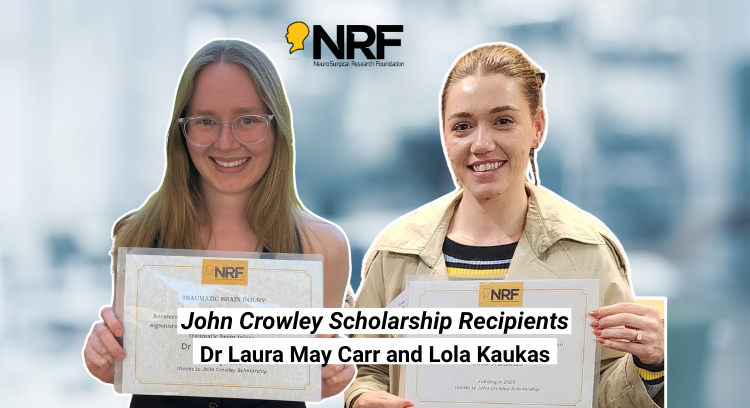
The NeuroSurgical Research Foundation is pleased to announce the recipients of the 2025 John Crowley Scholarships, supporting research focused on improving outcomes for people affected by traumatic brain injury (TBI) and chronic subdural haematoma (cSDH).
The scholarship honours the memory of John Crowley, who was in his final year as a nursing student at the Royal Adelaide Hospital, when he tragically passed away from a head injury sustained as the result of a motorcycle accident. His legacy now supports emerging researchers dedicated to improving care for others affected by life-changing brain injuries.
This year’s scholarships have been awarded to Dr Laura May Carr and Lola Kaukas, whose work spans laboratory research and real-world clinical care.
Understanding Accelerated Ageing After Traumatic Brain Injury
Dr Laura May Carr completed her PhD investigating how ageing alters the brain’s immune system and how these changes may contribute to neurodegenerative disease.
Her research now focuses on how traumatic brain injury may accelerate brain ageing, and whether protective pathways, such as those involving the Klotho gene, can influence long-term recovery.
“A significant number of people who experience a TBI go on to develop long-lasting deficits, often persisting decades after the initial injury,” Laura explains. “Growing evidence suggests TBI may accelerate brain ageing, contributing to this progressive decline.”
“By understanding how injury and ageing intersect, and whether pathways such as Klotho signalling can modify these outcomes, we hope to identify new biomarkers that can predict recovery and ultimately develop therapeutic strategies to improve quality of life for patients living with chronic effects of TBI.”
“I am deeply grateful to the Crowley family for supporting this work,” Laura says. “Their generosity enables research that has the potential to change the lives of people living with the long-term consequences of traumatic brain injury.”
Predicting Outcomes in Chronic Subdural Haematoma
Chronic subdural haematoma is one of the most common neurosurgical conditions affecting older adults, with prevalence expected to rise as the population ages. While surgical treatment is often effective, up to 30% of patients experience recurrence, sometimes requiring additional surgery and prolonged recovery.
Lola Kaukas, Clinical Neurosurgery Research Officer at the Royal Adelaide Hospital Department of Neurosurgery, is leading this project aiming to uncover why this occurs. The research examines both the protein composition of cSDH fluid and how blood clotting behaves throughout the body, helping build a clearer picture of why outcomes vary so widely between individuals.
“Our aim is to build the foundations of more personalised cSDH care,” Lola explains. “By better identifying those most likely to experience recurrence, clinicians can tailor management accordingly and help patients better understand what to expect following treatment.”
Alongside this project, Lola currently supports nine active research studies within the RAH Department of Neurosurgery and mentors students from both Flinders University and The University of Adelaide. Supported through NRF grant funding made possible thanks to your generosity, her role embeds research into day-to-day clinical practice, ensuring discoveries translate into meaningful improvements for patients.
“I, along with the team at the RAH Department of Neurosurgery, extend our warmest gratitude to the Crowley family,” Lola says. “Their generous support plays a vital role in advancing research that aims to make a real difference in patients’ outcomes. Thank you for believing in this work.”
A Lasting Impact
Through the John Crowley Scholarship, the Crowley family’s generosity continues to support meaningful advances in neurotrauma research, alongside all our supporters who are helping fund vital research to improve outcomes for people affected by brain injury.
