



New discovery reveals hidden driver of deadly brain cancer
NRF-supported research uncovers pathway driving glioblastoma growth and spread
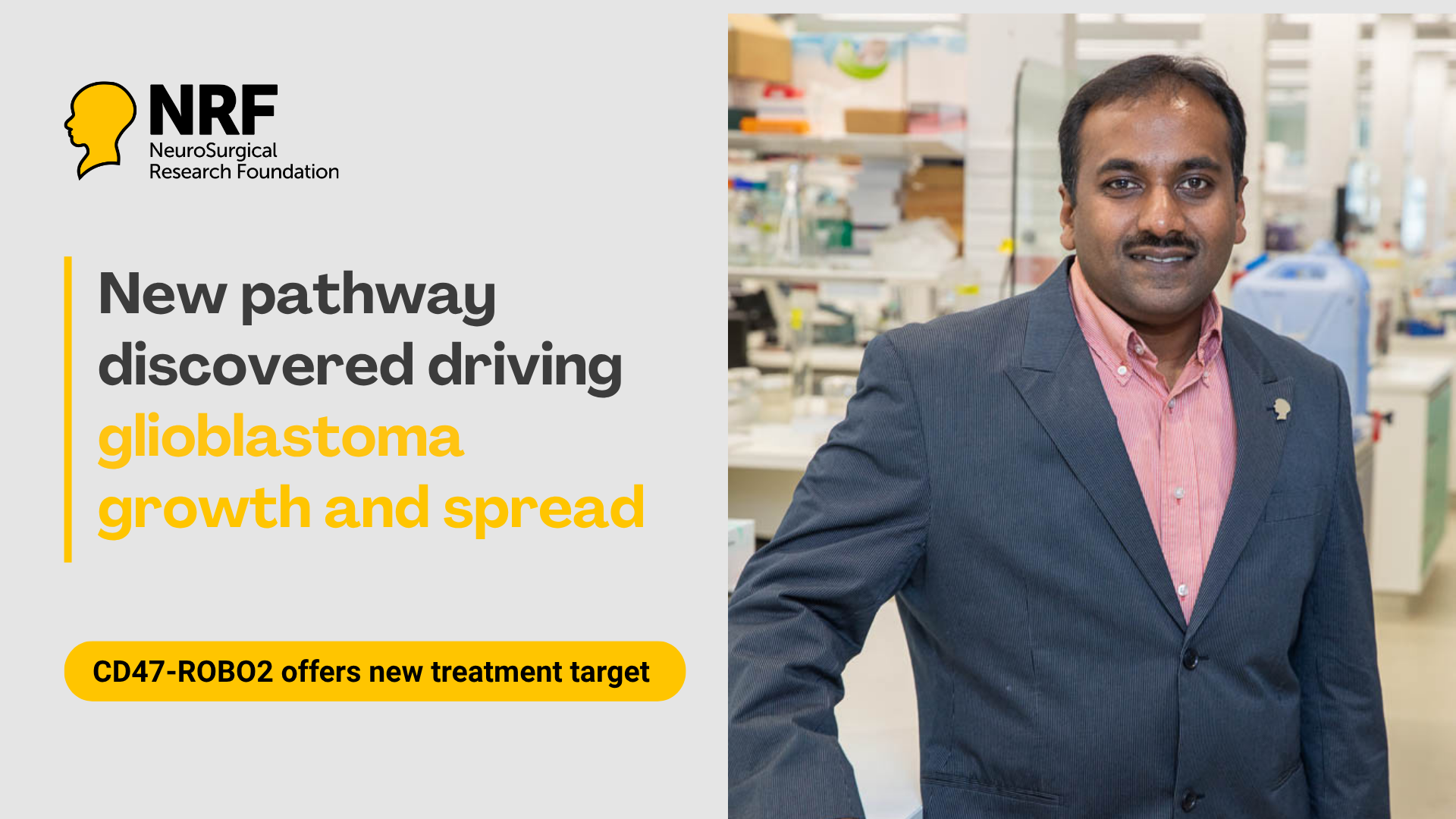
SA researchers at the Centre for Cancer Biology have uncovered a critical mechanism driving the growth and spread of glioblastoma — one of the most aggressive and difficult-to-treat forms of brain cancer.
The discovery, recently published in the scientific journal Proceedings of the National Academy of Sciences (PNAS), reveals that a protein called CD47 plays a much larger role in tumour behaviour than previously understood.
"We've known for some time that CD47 acts as a kind of 'don't eat me' signal that helps cancer cells hide from the immune system," said Dr Nirmal Robinson , senior author of the study.
"What we've discovered is that CD47 is doing much more than that; it's actually driving the cancer's ability to spread and grow."
Glioblastoma remains one of the most devastating cancers, with most patients surviving less than 18 months after diagnosis despite surgery, radiotherapy and chemotherapy.
Understanding the biological mechanisms that allow these tumours to grow and invade healthy brain tissue is critical for developing new treatments.
The research team found that CD47 is particularly abundant at the invasive edges of glioblastoma tumours — the areas responsible for cancer spreading into healthy brain tissue.
When researchers removed or blocked CD47 in laboratory models, tumour growth slowed dramatically and cancer cells lost much of their ability to invade surrounding brain tissue.
This breakthrough builds on years of research supported by the NeuroSurgical Research Foundation and its community of donors.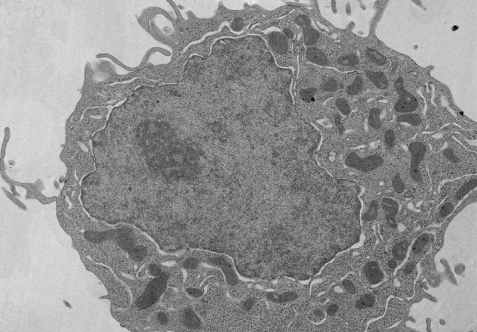
A new pathway for future treatments
The team also identified another protein, ROBO2, which works together with CD47 to drive tumour progression.
Researchers discovered that CD47 protects ROBO2 from being broken down inside cancer cells, allowing it to accumulate and fuel tumour growth.
"Essentially, CD47 is shielding ROBO2, allowing it to accumulate and drive tumour progression," according to Dr Ruhi Polara , who led the research alongside Dr Robinson.
"When we remove CD47, ROBO2 is degraded, and the cancer cells lose their ability to grow and invade effectively," Dr Polara said.
This newly identified CD47-ITCH-ROBO2 pathway provides scientists with an important new target for future therapies.
“This work changes how we think about CD47,” Dr Robinson said.
“It’s not just an immune checkpoint; it’s a central regulator of tumour biology.”
The researchers say further studies are needed to translate these findings into clinical treatments, but the discovery represents a significant step forward in the fight against one of the most devastating cancers.
Read the research paper:
https://doi.org/10.1073/pnas.2602460123
"This achievement reflects a truly collaborative effort, and we are grateful to all co-authors and partners involved. We specifically thank Stuart Pitson lab and Briony Gliddon for the collaboration. We also extend our deep appreciation to philanthropists and, most importantly, to the patients who generously donated samples, as well as the South Australian Neurological Tumor Bank (SANTB) for their invaluable support."
Research powered by supporters
Scientific breakthroughs rarely happen overnight.
They are the result of years of research, collaboration, and the support of people who believe a better future is possible.
This breakthrough has been supported by multiple NRF research grants across several years, as well as the Chris Adams Research Grant which was awarded to Dr Ruhi Polara in 2025 to support her PhD research enabling her to lead this important project.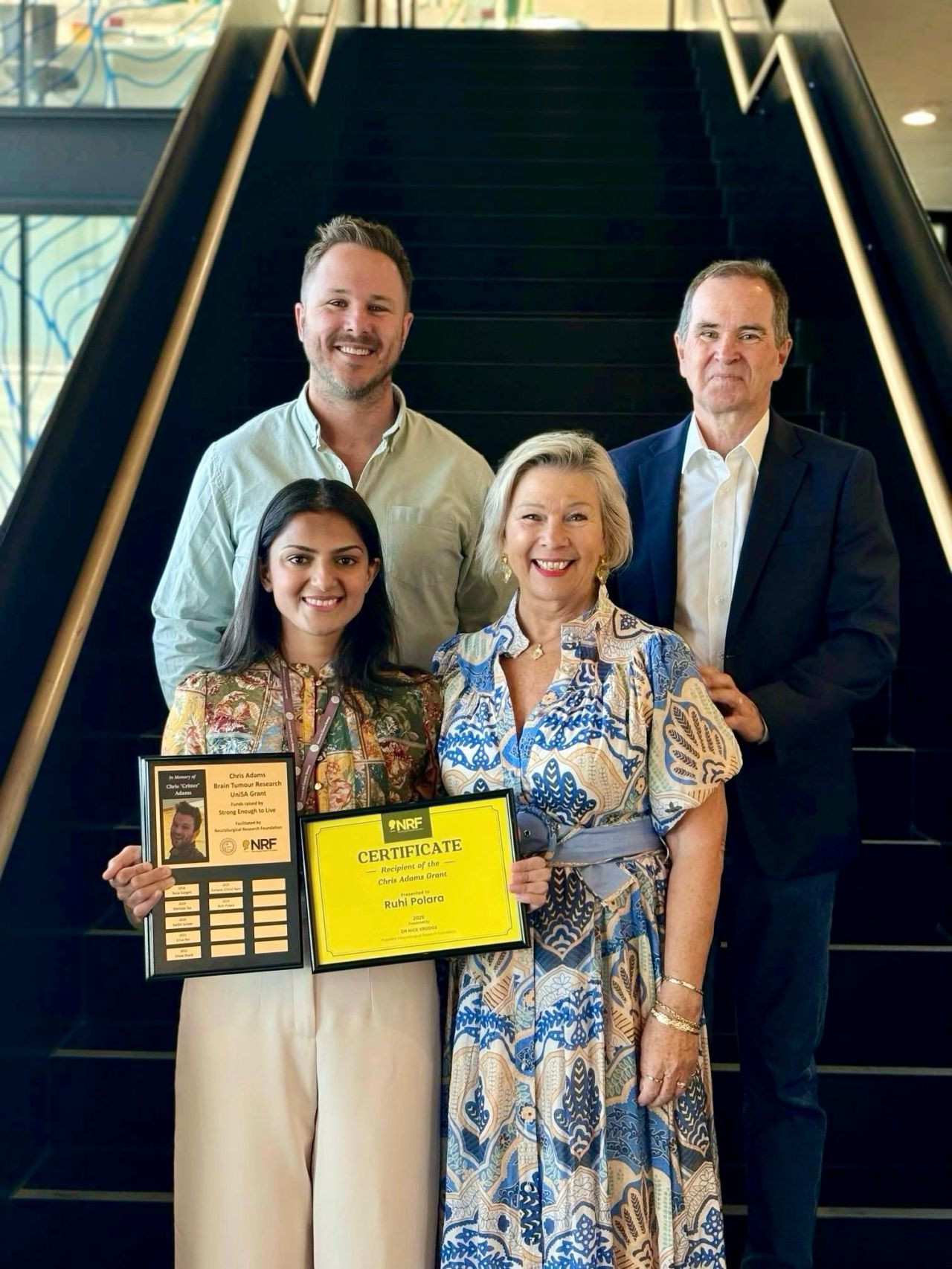
Dr Ruhi Polara pictured with the Adams family receiving the Chris Adams Research Grant, named in honour of Chris Adams who passed away from brain cancer aged 26
Thanks to the generosity of donors, fundraisers and partners, the NeuroSurgical Research Foundation is the largest funder of SA brain tumour research, supporting Adelaide’s world-class brain tumour research community.
“We are really grateful to the Neurosurgical Research Foundation because they were the ones before we got funding from the NHMRC, who had been funding this project since we started off”, said Dr Robinson. “But to take it to the next level we definitely need more funding”.
By supporting research today, you are helping drive the discoveries that could lead to better treatments — and better outcomes — for people facing brain cancer.
