Home >> Survivor Stories >> Cadel
Cadel

Living with hydrocephalus.
Our journey to parenthood wasn’t an easy one. It took 3 years, surgery to treat endometriosis, IVF, a miscarriage and a sea of tears to fall pregnant.
Our son Cadel was born at 32 weeks due to firther complications. He was delivered via emergency c-section under a general anaesthetic on September 11 2007, and thankfully he was born as healthy as a 32 weeker could be.
We thought the hard part was over, and that by his due date we would be home with our healthy baby reminiscing about the long 8 weeks in hospital.
It turned out that Cadel’s dramatic entrance into the world was just the beginning.
At around 2 weeks old Cadel became unwell. He was lethargic, vomited regularly and I began noticing some odd eye movements. It became apparent how serious things were when Cadel seized and turned blue while I was changing his nappy. A quick thinking nurse gave Cadel some oxygen and he began breathing again, but he continued having seizures throughout the day and needed oxygen several times. Later that evening he had yet another seizure while his paediatrician was examining him, she decided that they should begin treating Cadel for an infection immediately Cadel had had E-Coli meningitis; the statistics say that he shouldn’t be here with us today.
Slowly Cadel began to recover and his morphine cocktail was weaned down. He began to spend short periods of time awake; our little man was coming back to us! He spent nine days on the ventilator and three more weeks in Special Care. On the 1st of November we finally went home as a family.
A week after we got home we took Cadel for a follow up ultrasound on his brain, it showed increased fluid on the brain, and Cadel was diagnosed with Hydrocephalus. We were flown down to Adelaide (we were living in Darwin) where he had his first shunt operation on November 16. The shunt was placed to divert the excess fluid from his brain to the space in his abdominal cavity, without this the excess pressure would lead to brain damage and eventually death. The surgery went smoothly and we were sent home.
We were due in Adelaide in February for a follow up with the Neurosurgeon. Cadel began having seizures in January, so we organised an MRI to be done to take with us. We assumed scarring on the brain was causing these seizures, and that Cadel was outgrowing the doses of medication that were previously controlling them. Unfortunately the MRI showed that it was actually the Hydrocephalus causing the seizures, we were told that his shunt was no longer working.
When we arrived in Adelaide and met with Cadel’s surgeon she told us that his shunt was working perfectly, but that there were several other pockets of fluid within his brain that were unable to drain through the usual pathways. She told us that the ventricles (fluid filled spaces) in his brain looked like "a row of sausages", separated by masses of messy debris left behind by the meningitis. We were told the only way to help the fluid flow correctly was with risky microscopic brain surgery, but despite their best efforts he would more than likely need extra shunts. We immediately made the decision to stay in Adelaide permanently to ensure Cadel received the ongoing care he needed.
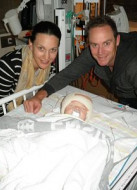
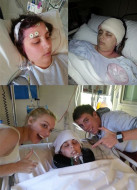
Fast forward 12 months and Cadel has had 17 separate brain surgeries, 43 scans, survived two more infections in his brain and spent over six months of his life in hospital.
Cadel now lives with two shunts, and each of those shunts drains two separate areas of the brain. Shunts will fail by becoming blocked or infected in 40% of paediatric patients within the first year of being placed. Cadel has this risk times four.
Now we are home our main focus is therapy. The meningitis has left Cadel with damage to the areas of his brain that effect his muscle movement and it is likely that in the future he will be diagnosed with Cerebral Palsy. Cadel does hydrotherapy, has daily massage, daily physical therapy and has a long list of specialists involved in his ongoing care. His development is delayed, but Phil and I don’t worry about meeting milestones, we accept that he will set his own pace. Out of hospital he is going ahead in leaps and bounds, we love watching him grow and learn.
Cadel has had barriers put up in front of him at every turn, and he hasn’t just broken them down, he has smashed them! Every day he amazes us not only with his progress, but with his cheery personality. He is a happy, cheeky little monkey and despite everything he has been through he has a smile and a cuddle for everyone he meets. We are so incredibly lucky to have Cadel in our lives and are grateful each and every day that he fought so hard to still be here with us. My son, quite simply, is my hero.